Back
Feb 10, 2026
Digital Assets, Trust and Infrastructure: Notes from Davos 2026
At this year's World Economic Forum in Davos, it was clear that digital assets is a sector moving toward its moment. In the sessions I attended and the conversations I had, tokenisation was discussed as infrastructure already in use across parts of today’s financial system.
I heard perspectives on the technology that have circulated quietly within institutions now voiced publicly, confirming to me that digital assets belong in the same conversation as capital markets, payments, and financial infrastructure.
This growing confidence reflects the progress large institutions have made over years of work on tokenisation, shared ledgers, and new settlement models. Davos 2026 simply put a spotlight on what we have all been quietly building.
From Tokenisation to Operational Reality
Real-world asset tokenisation has now surpassed 21 billion dollars in total value locked. This number matters less for its scale than for what it signals; a move from pilots to production. Executives from BlackRock, Coinbase, and Euroclear are no longer debating whether tokenisation will work, but how to make it operational across institutions.
In conversations, three benefits came up. Fractional ownership, opening access to new investor bases. Faster settlement, compressing timelines from days to minutes. And direct integration with existing financial systems, rather than parallel infrastructure, all of which are already being deployed.
And the regulatory clarity achieved in late 2025, particularly in the United States and Europe, emerged as a decisive catalyst. As legal frameworks around stablecoins and digital asset infrastructure have solidified, institutions have moved beyond sandbox environments and committed real capital and operational resources. A very big step.
Stablecoins as Infrastructure
As anyone in the DLT space will tell you, payments remain one of the clearest pressure points in the global system. Cross-border delays, trapped liquidity, and complex workarounds are familiar to those operating at scale. Stablecoins are being adopted because they sit directly on those fault lines and are the best fix for many of these issues.
In the sessions “Where Are We on Stablecoins?”, policymakers, financial institutions, and crypto-native firms focused less on feasibility and more on resilience. Discussions centred on what holds up under stress, where failure points emerge, and what really changes when settlement moves from days to seconds and costs fall from percentages to fractions of a penny, anywhere and any time.
The emerging consensus now treats stablecoins as financial infrastructure. This new framing brings clear expectations around governance, including who can issue, who can intervene, and where responsibility lies when markets move quickly, questions that apply equally to private stablecoin networks and central bank digital currencies.
Carbon Markets: From Opacity to Transparency
Carbon markets were discussed in the same practical way, with attention focusing on where systems strain under regulatory and operational pressure. Credits are created in one place, verified in another, traded elsewhere, and then retired. As volumes grow and regulation tightens, every handoff becomes harder to track and to justify.
The core issue I noticed was confidence. Distributed ledgers and digital identity were presented as solutions to a concrete problem, providing regulators and market participants with a complete, inspectable record rather than a patchwork of attestations, a system that isn't working.
An announcement at Davos highlighted this shift. EcoGuard Global and CONFED signed an agreement to build the Philippines’ first digital carbon office on Hedera, digitising their entire carbon credit lifecycle at a national scale. The system is designed to support audits, meet regulatory requirements, and operate at scale without relying on manual processes or institutional trust alone.
Identity and Accountability at Scale
As financial systems increasingly automate the execution of payments and related actions regulators and auditors require even clearer accountability. This includes understanding who initiated each action, under what authority it was taken, and which rules applied at the time.
Once systems operate at speed and without human intervention, records move from the back office to the centre of trust, and provenance and accountability become prerequisites rather than features. This applies across financial flows, digital identity, public services, and all AI-enabled processes.
And at scale, across borders and institutions, confidence depends on the ability to reconstruct events precisely and without ambiguity. Where that is not possible, adoption will definitely stall.
What Holds Up Under Pressure
Across discussions, I noticed institutions returning to a single concern. When conditions deteriorate through market stress, geopolitical tension, or infrastructure failure, does the system still function?
The difference between resilient systems and fragile ones comes down to three operational requirements:
Clear ownership: Who's accountable when things break?
Coordination mechanisms: Can institutions act together quickly?
Explicit decision rights: Who makes the calls when problems come?
Where these elements fail under pressure, systems fail with them. Successful deployments reinforce these points early. Failed ones discover the gaps too late and once real money and real responsibility are involved, reliability becomes the only metric that matters.
What Comes Next
What became clear to me in Davos this year is that the next phase of digital asset adoption will be shaped by collaboration between financial institutions, technology providers, regulators, and infrastructure players, with the shared goal of a financial system that is much more efficient, transparent, and resilient.
Tokenisation has crossed a critical threshold. The infrastructure is now operational, regulatory frameworks are coming into place, and major institutions are committing capital. The focus has evolved to find out how quickly the global ecosystem can mature to support deployment at scale, and whether governance models can keep pace with growing technical capability.
At The Hashgraph Association, we are committed to supporting this transition. Working with our ecosystem, partners, members, and community, we focus on enabling everyone to adopt these technologies at a sustainable pace, with full commitment to building with the highest levels of security, reliability, and real-world function.
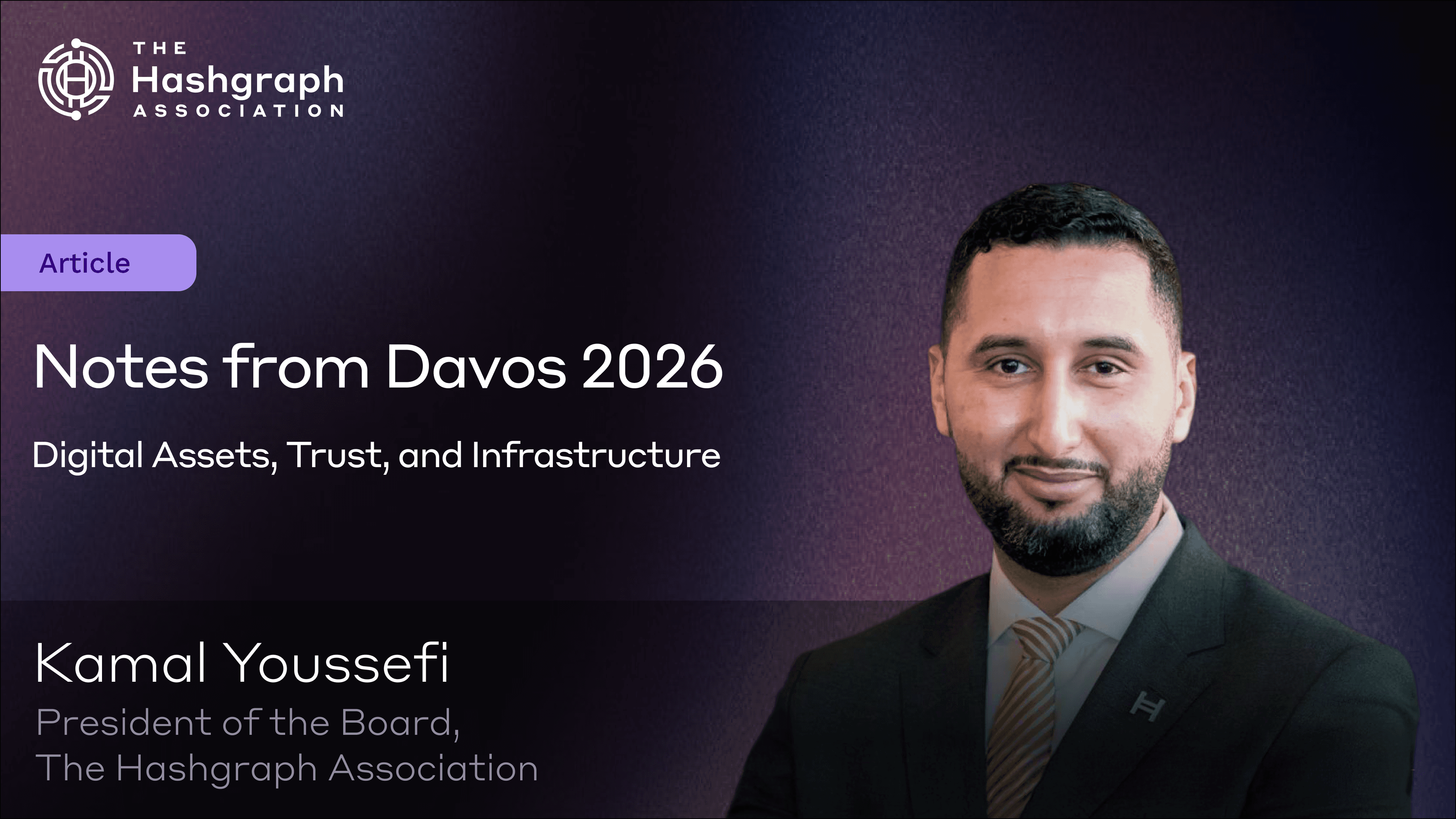
Kamal Youssefi is the President of the Board of The Hashgraph Association .
The Hashgraph Association is a Swiss-based organization dedicated to advancing the global adoption of Hedera's distributed ledger technology through enterprise collaboration, education, and ecosystem development.
Source: LinkedIn